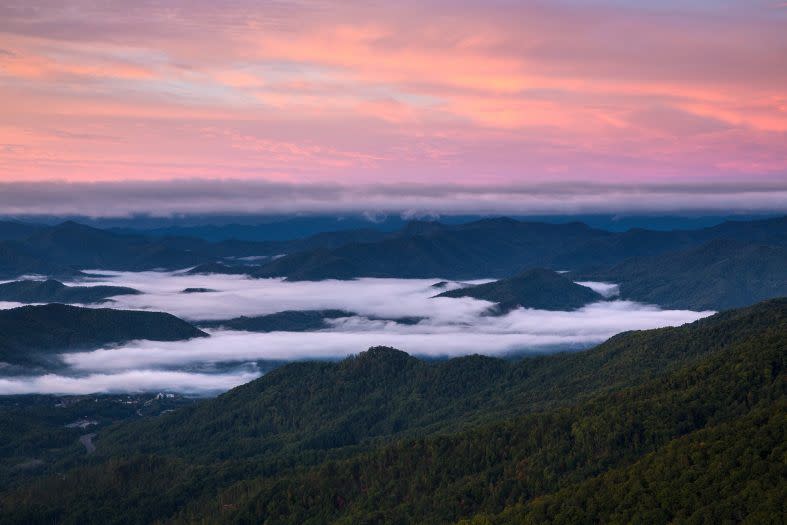
 Sunset view from the Pinnacle, Sylva, NC[/caption]
Plant-inspired names are plentiful as well. We find, again according to the alphabet, Cedar Cliff, Cedar Cliff Mountain, Cherry Knob, Chestnut Knob, two Chestnut Mountains, Dryland Laurel, Fern Mountain, Grassy Knob, Grassy Top, Hickory Flat Knob, Hickory Flats, Hickory Mountain, two Laurel Knobs, Moss Knob, Pine Knob, Piney Cliff, Piney Knob, Piney Mountain, Piney Ridge Knob, Poplar Mountain, Potato Knob, Prickly Ash Mountain, Rye Mountain and two Sassafras Knobs.
Some appear to have been named according to their shape, size or other characteristics: Awl Knob, Big Knob, Big Mountain, Chimneytop Mountain, Coldsides Mountain, Cove Hill, Double Knob, Double Top, two Doubletop Mountains, Flat Mountain, two High Knobs, High Point, two High Tops, Lone Bald, Pinnacle, Pump Mountain, three Rocky Faces, Round Mountain, View Rock and Whiteside Mountain.
“Little” mountains are especially popular. We find Little Bald Rock Mountain, Little Cow Mountain, Little Green Mountain, Little Hogback Mountain, Little Panther Knob, Little Pilot Mountain, Little Sheep Cliff and Little Terrapin Mountain.
Our mountains are mostly in the 4,000- to 5,000-foot range, but we do have nine below 3,000 feet. Pine Ridge is the shortest at 2,300 feet.
The most intriguing name? Tuckasegee’s Lost Knob. How could anyone lose a mountain that stands 5,467 feet above sea level?
Sunset view from the Pinnacle, Sylva, NC[/caption]
Plant-inspired names are plentiful as well. We find, again according to the alphabet, Cedar Cliff, Cedar Cliff Mountain, Cherry Knob, Chestnut Knob, two Chestnut Mountains, Dryland Laurel, Fern Mountain, Grassy Knob, Grassy Top, Hickory Flat Knob, Hickory Flats, Hickory Mountain, two Laurel Knobs, Moss Knob, Pine Knob, Piney Cliff, Piney Knob, Piney Mountain, Piney Ridge Knob, Poplar Mountain, Potato Knob, Prickly Ash Mountain, Rye Mountain and two Sassafras Knobs.
Some appear to have been named according to their shape, size or other characteristics: Awl Knob, Big Knob, Big Mountain, Chimneytop Mountain, Coldsides Mountain, Cove Hill, Double Knob, Double Top, two Doubletop Mountains, Flat Mountain, two High Knobs, High Point, two High Tops, Lone Bald, Pinnacle, Pump Mountain, three Rocky Faces, Round Mountain, View Rock and Whiteside Mountain.
“Little” mountains are especially popular. We find Little Bald Rock Mountain, Little Cow Mountain, Little Green Mountain, Little Hogback Mountain, Little Panther Knob, Little Pilot Mountain, Little Sheep Cliff and Little Terrapin Mountain.
Our mountains are mostly in the 4,000- to 5,000-foot range, but we do have nine below 3,000 feet. Pine Ridge is the shortest at 2,300 feet.
The most intriguing name? Tuckasegee’s Lost Knob. How could anyone lose a mountain that stands 5,467 feet above sea level?
So Many Mountains
Sunset view from the Pinnacle, Sylva, NC[/caption]
Plant-inspired names are plentiful as well. We find, again according to the alphabet, Cedar Cliff, Cedar Cliff Mountain, Cherry Knob, Chestnut Knob, two Chestnut Mountains, Dryland Laurel, Fern Mountain, Grassy Knob, Grassy Top, Hickory Flat Knob, Hickory Flats, Hickory Mountain, two Laurel Knobs, Moss Knob, Pine Knob, Piney Cliff, Piney Knob, Piney Mountain, Piney Ridge Knob, Poplar Mountain, Potato Knob, Prickly Ash Mountain, Rye Mountain and two Sassafras Knobs.
Some appear to have been named according to their shape, size or other characteristics: Awl Knob, Big Knob, Big Mountain, Chimneytop Mountain, Coldsides Mountain, Cove Hill, Double Knob, Double Top, two Doubletop Mountains, Flat Mountain, two High Knobs, High Point, two High Tops, Lone Bald, Pinnacle, Pump Mountain, three Rocky Faces, Round Mountain, View Rock and Whiteside Mountain.
“Little” mountains are especially popular. We find Little Bald Rock Mountain, Little Cow Mountain, Little Green Mountain, Little Hogback Mountain, Little Panther Knob, Little Pilot Mountain, Little Sheep Cliff and Little Terrapin Mountain.
Our mountains are mostly in the 4,000- to 5,000-foot range, but we do have nine below 3,000 feet. Pine Ridge is the shortest at 2,300 feet.
The most intriguing name? Tuckasegee’s Lost Knob. How could anyone lose a mountain that stands 5,467 feet above sea level?